
Map
字数: 0 字 时长: 0 分钟
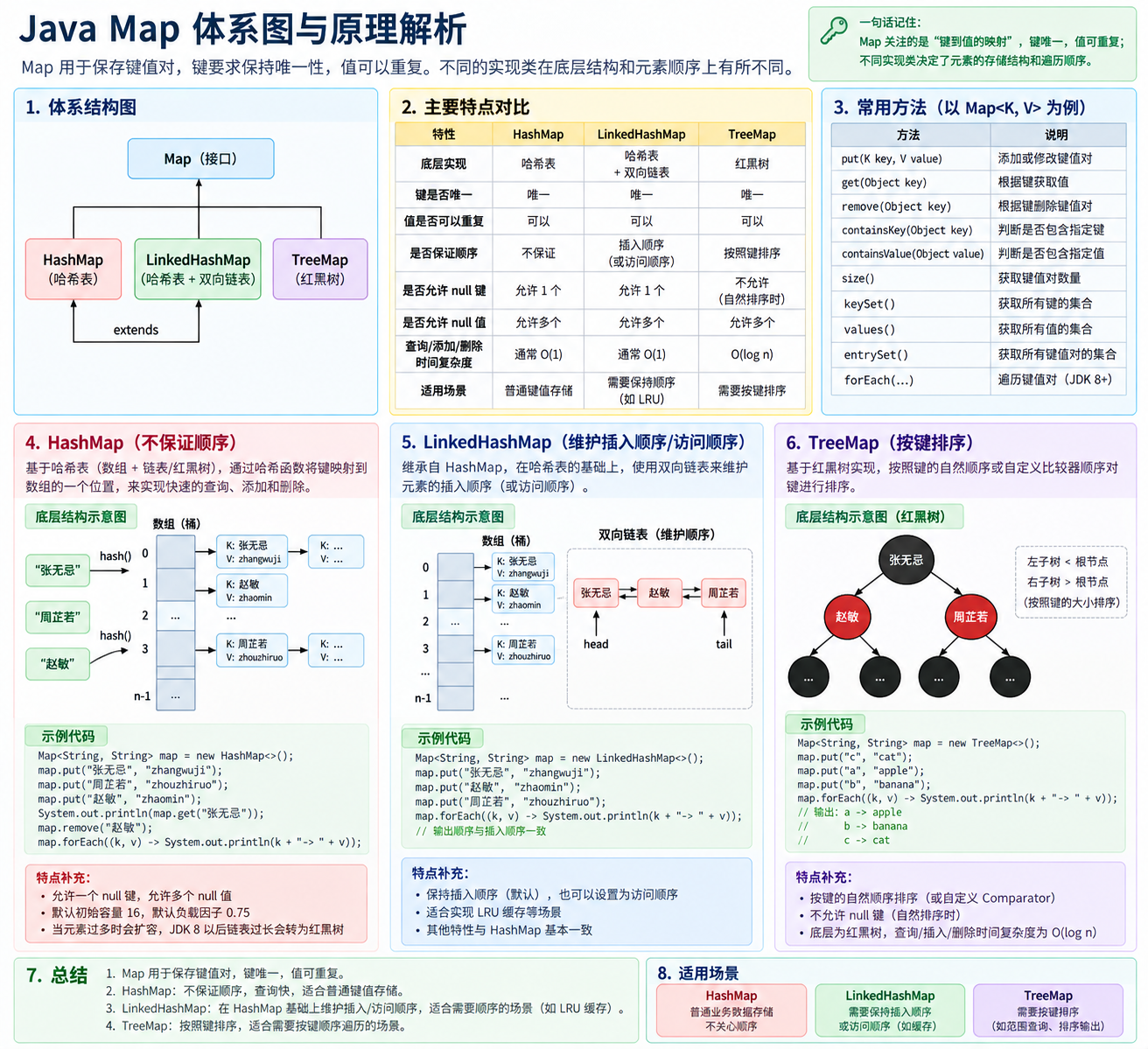
1. Map
Map 用于保存:
text
Key → Value
键值对它和 List、Set 最大的区别是:
text
List / Set
    ↓
保存单个元素


Map
    ↓
保存 Key 和 ValueMap 的核心特点:
- Key 不能重复
- Value 可以重复
- 通过
Key查找对应的Value - 同一个
Key再次put(),会覆盖原来的Value
例如:
java
Map<String, String> map =
        new HashMap<>();

map.put(
        "张无忌",
        "zhangwuji"
);

map.put(
        "赵敏",
        "zhaomin"
);可以理解:
text
张无忌 → zhangwuji

赵敏 → zhaomin常见实现:
text
Map
├── HashMap
├── LinkedHashMap
└── TreeMap三者最主要的区别:
text
HashMap
    ↓
不保证遍历顺序


LinkedHashMap
    ↓
可以维护插入顺序 / 访问顺序


TreeMap
    ↓
按照 Key 排序1.1 HashMap
HashMap 是最常用的 Map 实现之一。
它通过:
text
Key
    ↓
hash
    ↓
定位对应位置来实现较快的:
text
查询

添加

删除基本使用:
java
Map<String, String> map =
        new HashMap<>();

// 添加
map.put(
        "张无忌",
        "zhangwuji"
);

map.put(
        "周芷若",
        "zhouzhiruo"
);

map.put(
        "赵敏",
        "zhaomin"
);

// 查询
String value =
        map.get(
                "张无忌"
        );

// 修改
map.put(
        "张无忌",
        "zhangsanfeng"
);

// 删除
map.remove(
        "赵敏"
);

// 遍历
for (
        Map.Entry<String, String>
                entry :
                map.entrySet()
) {

    System.out.println(
            entry.getKey()
                    + " → "
                    + entry.getValue()
    );
}1.1.1 HashMap 的特点
主要特点:
text
Key 不能重复

Value 可以重复

不保证遍历顺序

允许一个 null Key

允许多个 null Value

查询、添加、删除通常较快如果重复加入同一个 Key:
java
map.put(
        "张无忌",
        "zhangwuji"
);

map.put(
        "张无忌",
        "zhangsanfeng"
);最终:
text
张无忌 → zhangsanfeng原来的 Value 会被覆盖。
1.1.2 容量和负载因子
HashMap 有两个比较重要的概念:
text
容量
Capacity


负载因子
Load Factor常见默认负载因子:
text
0.75当元素达到一定数量后:
text
容量不足
    ↓
触发扩容
    ↓
重新组织内部数据HashMap 的:
text
hash 原理

put / get

扩容

负载因子

红黑树

JDK 7 / JDK 8 差异后面在 HashMap.md 中单独整理。
1.2 LinkedHashMap
LinkedHashMap 是:
java
HashMap的子类。
它可以简单理解为:
HashMap + 双向链表。
text
HashMap
    ↓
负责保存和查找数据


双向链表
    ↓
负责维护元素顺序因此它既拥有类似 HashMap 的键值查找能力,又能够维护确定的遍历顺序。
1.2.1 LinkedHashMap 基本使用
java
Map<String, String> map =
        new LinkedHashMap<>();

map.put(
        "张无忌",
        "zhangwuji"
);

map.put(
        "赵敏",
        "zhaomin"
);

map.put(
        "周芷若",
        "zhouzhiruo"
);

for (
        Map.Entry<String, String>
                entry :
                map.entrySet()
) {

    System.out.println(
            entry.getKey()
                    + " → "
                    + entry.getValue()
    );
}按照默认的插入顺序遍历:
text
张无忌 → zhangwuji

赵敏 → zhaomin

周芷若 → zhouzhiruo而 HashMap:
java
Map<String, String> map =
new HashMap<>();不保证按照:
text
put() 的插入顺序进行遍历。
1.2.2 LinkedHashMap 的特点
主要特点:
text
Key 不能重复

基于 HashMap

额外使用双向链表维护顺序

默认维护插入顺序

也可以维护访问顺序所以可以简单记:
text
HashMap
    ↓
不关心顺序


LinkedHashMap
    ↓
HashMap + 顺序LinkedHashMap 还可以配置:
text
accessOrder按照访问顺序维护元素。
这种能力可以用于实现:
text
LRU 缓存相关内容后面放到 Map.md 或缓存部分再展开。
1.3 TreeMap
TreeMap 是一个:
可以按照 Key 自动排序的 Map。
它实现了:
java
NavigableMap而 NavigableMap 又继承:
java
SortedMap底层使用:
text
红黑树保存键值对。
因此:
text
TreeMap
    ↓
Key 唯一
    ↓
根据 Key 排序1.3.1 TreeMap 基本使用
java
Map<String, String> map =
        new TreeMap<>();

map.put(
        "周芷若",
        "zhouzhiruo"
);

map.put(
        "张无忌",
        "zhangwuji"
);

map.put(
        "赵敏",
        "zhaomin"
);

// 查询
String value =
        map.get(
                "张无忌"
        );

// 修改
map.put(
        "张无忌",
        "newzhangwuji"
);

// 删除
map.remove(
        "周芷若"
);

// 遍历
for (
        Map.Entry<String, String>
                entry :
                map.entrySet()
) {

    System.out.println(
            entry.getKey()
                    + " → "
                    + entry.getValue()
    );
}1.3.2 TreeMap 自动排序
例如:
java
Map<String, String> map =
        new TreeMap<>();

map.put(
        "c",
        "cat"
);

map.put(
        "a",
        "apple"
);

map.put(
        "b",
        "banana"
);

for (
        Map.Entry<String, String>
                entry :
                map.entrySet()
) {

    System.out.println(
            entry.getKey()
                    + ": "
                    + entry.getValue()
    );
}输出:
text
a: apple
b: banana
c: cat可以看到:
text
插入顺序

c → a → b最终遍历顺序:
text
a → b → c因为 TreeMap 会按照:
text
Key 的自然顺序进行排序。
1.3.3 TreeMap 的排序方式
TreeMap 支持两种排序方式:
text
自然排序
Comparable或者:
text
自定义排序
Comparator例如:
java
Map<Integer, String> map =
        new TreeMap<>(
                Comparator.reverseOrder()
        );

map.put(
        1,
        "A"
);

map.put(
        3,
        "C"
);

map.put(
        2,
        "B"
);

System.out.println(
        map
);结果:
text
{3=C, 2=B, 1=A}所以可以简单记:
text
TreeMap
    ↓
红黑树
    ↓
按照 Key 排序
    ↓
Comparable / Comparator2. 小结
三个常见 Map 实现:
| 实现 | 底层特点 | 顺序 | 主要用途 |
|---|---|---|---|
HashMap | 哈希表 | 不保证顺序 | 普通键值存储 |
LinkedHashMap | 哈希表 + 双向链表 | 插入 / 访问顺序 | 需要保持顺序 |
TreeMap | 红黑树 | Key 排序 | 需要按照 Key 排序 |
可以直接这样选:
text
普通 Map
    ↓
HashMap


需要保持插入顺序
    ↓
LinkedHashMap


需要按照 Key 排序
    ↓
TreeMap一句话概括:
Map 保存的是唯一 Key 到 Value 的映射;HashMap 追求普通键值查找,LinkedHashMap 在此基础上维护顺序,TreeMap 则按照 Key 进行排序。